Google’s AI overviews are eating your clicks — here’s what that means for your business

There’s a quiet shift taking place in Google Search that many businesses haven’t fully noticed yet — but it’s already beginning to bite. We’re seeing it first-hand in some of our client accounts, especially in technical and niche sectors. These are businesses where search volumes are low, competition is high, and every single click really matters. In one such case, a worrying trend has emerged: while rankings are improving and impressions are growing, the number of actual clicks is on the decline.
This is not a story of lost visibility or poor SEO performance. In fact, the data shows quite the opposite. But it is a warning sign — and a strong indication that search behaviour is changing. The cause? Google’s new AI Overviews, and their growing presence in the search results.
What the data is telling us
The graph below comes directly from Google Search Console, representing a client account in a highly specialised B2B industry. What you’ll see is a fairly typical pattern emerging in recent months:
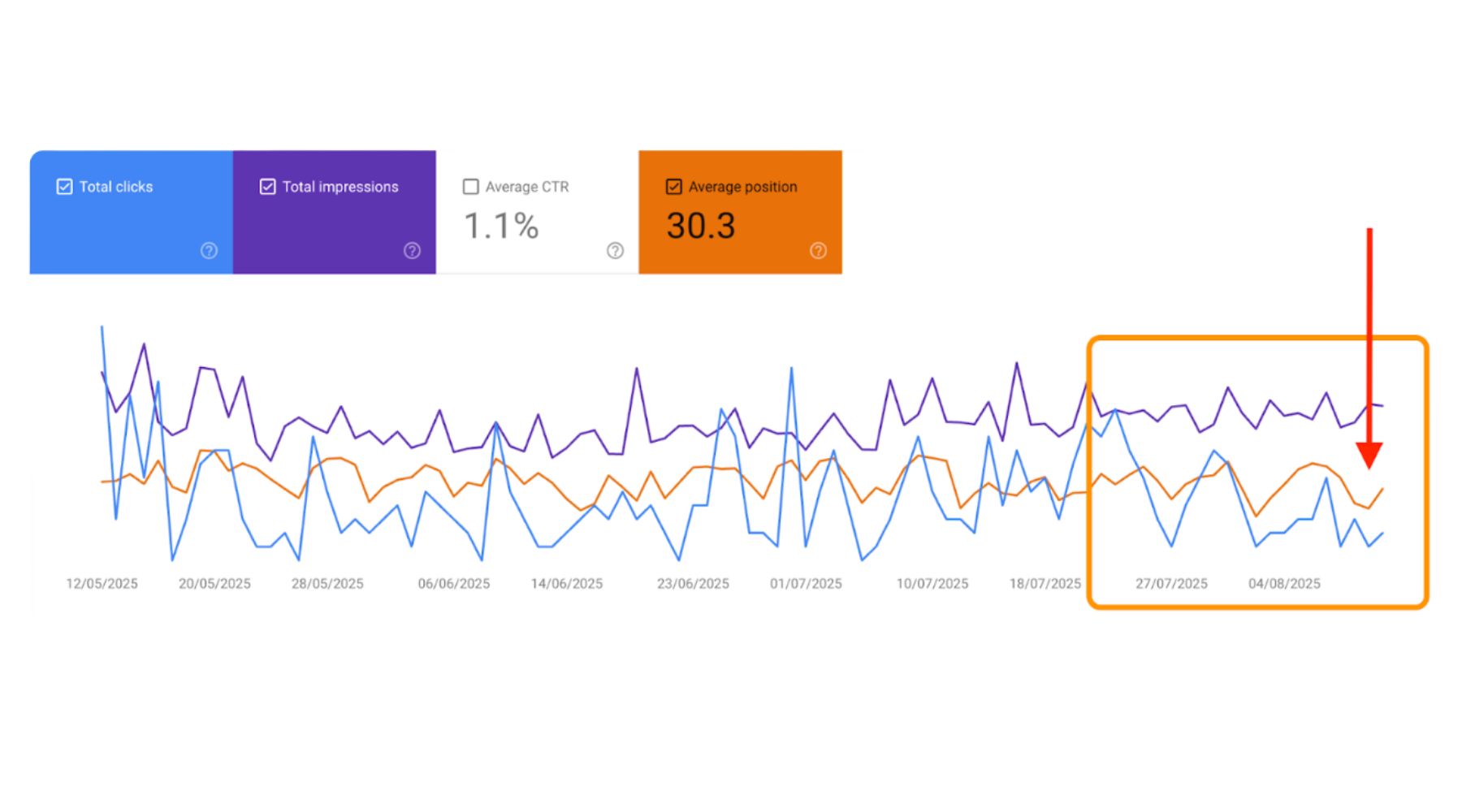
Firstly, the orange line indicates average position — and it’s heading in the right direction. Lower values mean higher rankings, and in this case, the client is appearing closer to the top of search results for their key terms. Secondly, the purple line shows impressions — how often the site is being shown in search. Again, the trend here is steady or even increasing, which confirms that visibility is not the issue.
However, the blue line — representing total clicks — is clearly dropping. In a niche market where organic traffic is a critical lead generator, that’s a major concern. We dug into the data further and found the issue wasn’t technical, nor was it a shift in keyword relevance. Instead, it’s something more structural: fewer users are clicking through from Google, because they’re getting the answers they need without ever leaving the results page.
The rise of AI overviews
Google’s AI Overviews — previously known as SGE (Search Generative Experience) — are AI-generated summaries that appear at the top of certain search results pages. These overviews attempt to answer the user’s query directly, drawing content from multiple sources and presenting it in a condensed, conversational format. While helpful to the user, the downside is obvious: when the answer is already in the search results, the need to click through to a website decreases dramatically.
This is especially damaging to businesses that rely on organic search traffic to attract prospects. You may be ranking on page one. You may even be in the top three results. But if the user’s question is answered in the AI overview, they may never scroll down far enough to see your link — let alone click it.
We’re not talking about small changes. In some queries, AI Overviews take up nearly the entire first screen on both mobile and desktop devices. The traditional ’10 blue links’ are increasingly buried below fold-level, making it harder than ever to drive traffic from organic search — even if your content is ranking well.
What this means for your SEO strategy
The implications are significant. Businesses can no longer rely on rankings alone. Metrics like impressions and position are still important, but they don’t guarantee traffic. In this new landscape, visibility without engagement is a very real challenge.
This change particularly affects businesses with content strategies built around answering common user questions — FAQs, how-to guides, explainers, and knowledge articles. While these formats still play an important role in building authority and trust, their click-through potential may be eroded if Google’s AI is able to summarise the answer within the search result itself.
That means marketers and content teams need to rethink not just how they rank, but how they capture user attention in the SERPs. The focus needs to shift towards content that is not only discoverable, but indispensable — content that provides a depth, perspective, or utility that a short AI snippet simply cannot replicate.
Actions you can take right now
So, what can you do to protect your organic traffic and continue driving value from search? Here are five practical actions we’re taking with our clients — and that you can start implementing today:
1. Optimise for Featured Snippets and Conversational Queries
While AI Overviews pull from multiple sources, featured snippets are still an opportunity to own the answer box. Structure your content clearly using subheadings, lists, and concise definitions. Use conversational phrasing in headings and body text to match how users speak and search.
2. Build Deeper, High-Value Content
Move beyond surface-level answers. Create content that explores topics in depth, includes expert commentary, data, or original research, and anticipates follow-up questions. This not only improves your chances of being cited in AI Overviews, but also encourages users to click through for more detail.
3. Strengthen Your Brand Signals and E-E-A-T
Google continues to emphasise content that demonstrates Experience, Expertise, Authoritativeness and Trustworthiness. Make sure authors are credited, credentials are clear, and your site’s about pages, reviews, and case studies reinforce your credibility.
4. Monitor Query-Level Performance Closely
Use Google Search Console to track changes in click-through rate at the query level. Identify keywords that are seeing a decline in clicks despite stable rankings. This will help you pinpoint which topics may be impacted by AI Overviews and where to adjust your approach.
5. Experiment With Alternative Formats
Consider using video, tools, calculators, and interactive formats that offer value beyond what can be summarised. Also, explore targeting transactional or navigational queries, which are less likely to be fully answered by AI summaries.
How we’re adapting our SEO strategy
At our agency, we’re actively evolving our SEO strategies to reflect this new reality. We’re not just chasing rankings — we’re evaluating how users behave in a changing SERP environment. For our clients, that means:
– Creating high-authority content hubs around complex, long-tail topics
– Auditing underperforming pages for changes in CTR and updating them accordingly
– Staying informed on Google’s AI rollout pace and adjusting targeting accordingly
We’re also experimenting with schema markup to increase eligibility for rich results and working to boost on-page engagement so that once users land, they stay longer and convert at higher rates.
Final thoughts: prepare now for the future of search
The days of relying solely on rankings and impressions to drive traffic are fading. Google’s AI Overviews represent a fundamental shift in how users interact with search results — and your SEO strategy needs to keep pace.
Understanding this change early gives you an edge. By adapting your content, tracking performance more closely, and delivering value that AI summaries can’t replace, your business can maintain and even grow its presence in search, despite the evolving landscape.